On May 13, I sent PRs to 10 MkDocs plugins in one go, all with the same change: switch the dependency from mkdocs to mkdocs-ng.
And none of them were merged.
One was closed the same day, with this reply from the author:
This plugin will work with any backwards-compatible fork without any changes, so I don’t see the point in sticking to a fork with low adoption.
Fair point. MkDocs NG was two weeks old at the time. If I were a plugin author, I probably wouldn’t have switched to mkdocs-ng either.
Six months later, I’m still maintaining it. On November 4, MkDocs NG 1.11.0 came out. This post is about what happened in those six months and why I keep going. (Earlier posts: why I forked, v1.7.x progress, the 1.8.0 release.)
Where MkDocs stands, and why I keep going#
The last 1.x release of MkDocs is 1.6.1 from August 2024, and there has been no release in more than two years. As for why it stopped being maintained, I wrote briefly about the back story before; if you’re curious, see why I forked.
Upstream’s focus is now MkDocs 2.0, a ground-up rewrite that is still a pre-release. It doesn’t run 1.x plugins or themes, so existing sites can’t simply upgrade to it.
Meanwhile, the community has gone in a few directions:
- Zensical: a new project from the team behind Material for MkDocs, with a core written in Rust, currently at 0.0.74. It reads
mkdocs.yml, but doesn’t run MkDocs plugins; it reimplements about thirty popular ones natively. - ProperDocs: a fork of 1.6 started by a former MkDocs maintainer, with its own package and command name. Its latest release is 1.6.7.
When people look at a fork, their first question is often: is it the original team?
I used to think that mattered a lot. Now I think a different question matters more to users: is someone committed to maintaining it for the long haul? People’s priorities change, and moving on to new work is normal. Each of these projects has people putting in that commitment in their own way. This post is about mine.
It comes from something practical: I can’t do without it. The docs sites of cpp-linter, commit-check and pipguard are all built with MkDocs. I run into what works and what gets in the way every day.
So when I took it over, I wasn’t looking to reinvent it. There was one goal: make sure this supply chain doesn’t break.
I accept what that plugin author said. There’s no reason for anyone to change dependencies for a fork that’s just getting started. So I turned the problem around: if plugins won’t change, MkDocs NG must not need them to.
Since 1.10, a plugin can keep mkdocs in its dependencies, and once mkdocs-ng is installed, MkDocs NG is what runs. Some plugins used to quietly swap NG back to upstream 1.6.1, and some printed a warning suggesting a different fork; both problems are gone. Later I closed all of those 10 PRs myself.
The most-upvoted upstream issues: mostly cleared#
Since taking over, most of my time has gone into fixing issues left behind upstream, especially the most-upvoted ones.
Sort upstream’s open issues by upvotes, and of the top 15:
- 10 are fixed in MkDocs NG. Among them the most-upvoted one,
mkdocs servenot watching for file changes (#4032, 70 upvotes), livereload needing an explicit flag (#4055), built-in themes loading from CDNs (#2171), no Python API for running MkDocs (#1240),INHERITaccepting only one file (#2624), and external links lackingrel="external"(#3914). - 1 is much improved: the performance and authoring experience of
mkdocs serve(#3695), more on that below. - The remaining 4: one is a joke (#892, “No beer me button”), and the other three are architectural changes (cache busting, splitting out the search plugin, decoupling themes from the core), planned for 1.12.
The full list is on Fixed Upstream Issues, which currently covers 27 upstream issues.
1.11.0: one mkdocs.yml for every language#
1.11.0 is the first final release since 1.9.0, with no breaking changes. The biggest new feature is multi-language sites:
# mkdocs.yml
languages:
  en: English
  zh: 中文
The default language goes at the site root, the others under /zh/ and so on. Translations sit next to the original (page.zh.md), and untranslated pages fall back to the default language, so no link breaks. Before, you needed one mkdocs.yml per language stitched together with INHERIT; now one is enough. See Multi-language Sites.
For everything else (faster serve, llms.txt, a JSON Schema for mkdocs.yml, GitHub-style > [!NOTE] alerts and more), see the Release Notes.
79 PRs in five days#
With Claude Code (Opus 5.5) behind me, from October 31 to November 4, five days, the mkdocs-ng organization merged 79 PRs: 39 in the main repository, 19 in Sumi, 8 in the plugin catalog and 7 in Material. Four releases went out: 1.9.0, 1.10.0rc1, 1.11.0rc1 and 1.11.0. One person in their spare time couldn’t have done that before.
My role is closer to a product owner: I explain the vision (what I want, what I don’t, what must never break), and AI handles the implementation, tests and docs. Even the outline of this post was dictated.
The direction is still mine to set, and not every proposal gets accepted. AI once suggested adding an mkdocs-ng command; I said no, because users’ CI scripts all say mkdocs, and a new command brings the migration cost right back. It also suggested having serve render the page being edited first; I turned that down twice and we kept to caching.
This is also why I think MkDocs NG can keep going. First, it’s my hobby. Second, my Claude Code was a gift from Anthropic, and the tokens are practically unlimited. Projects run by a full-time team have to fund that team, which is a different and harder problem; I’m lucky not to have it.
So as long as I have the will and the time, maintaining MkDocs NG is something I can just do.
Build speed#
The other surprise was performance.
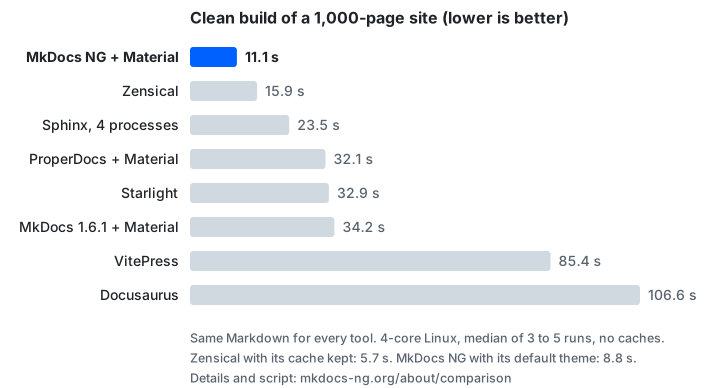
In our clean-build benchmark, MkDocs NG came out ahead. Honestly, I didn’t see that coming.
Looking back, it comes from keeping a close eye on performance. Since 1.8.0, every PR runs benchmarks on CodSpeed, and any regression is caught before merging. On that footing we optimized bit by bit: navigation rendering is no longer O(N²), serve reuses unchanged pages, the search plugin reads pages three times faster.
The same 1,000 pages of Markdown, the same 4-core machine, clean builds without caches:
| Tool | Theme | Time |
|---|---|---|
| MkDocs NG 1.11 | Default | 8.8 s |
| MkDocs NG 1.11 | Material | 11.1 s |
| MkDocs NG 1.11 | Sumi | 12.2 s |
| Zensical 0.0.74 | Its own (based on Material) | 15.9 s |
| MkDocs 1.6.1 | Default | 16.4 s |
| ProperDocs 1.6.7 | Default | 16.9 s |
| ProperDocs 1.6.7 | Material | 32.1 s |
| MkDocs 1.6.1 | Material | 34.2 s |
With Material, MkDocs NG takes 11.1 seconds against 34.2 for upstream 1.6.1, about a third of the time.
This is one benchmark on one kind of site, and the picture changes with caching:
- Zensical has a build cache. With its cache kept it takes only 5.7 seconds, faster than us. MkDocs NG has no cache between builds yet.
- From editing a page in
serveto seeing the result, Zensical and MkDocs NG (default theme) both take 1.2 seconds, a tie.
The method and script are public under Build speed. Your own site may behave differently, so feel free to run it on your machine, and if you spot a mistake in how any tool is set up, please tell me and I’ll fix it.
From 1.6.1 to 1.11 the language didn’t change; it’s still Python. All of the speed-up comes from changes like not re-rendering the navigation for every page and not recomputing pages that didn’t change.
Sumi: MkDocs NG’s own theme#
Sumi is the documentation theme I made for MkDocs NG. The name is Japanese for “ink”: paper, ink and a vermilion seal. Its ideas are borrowed from Oink.
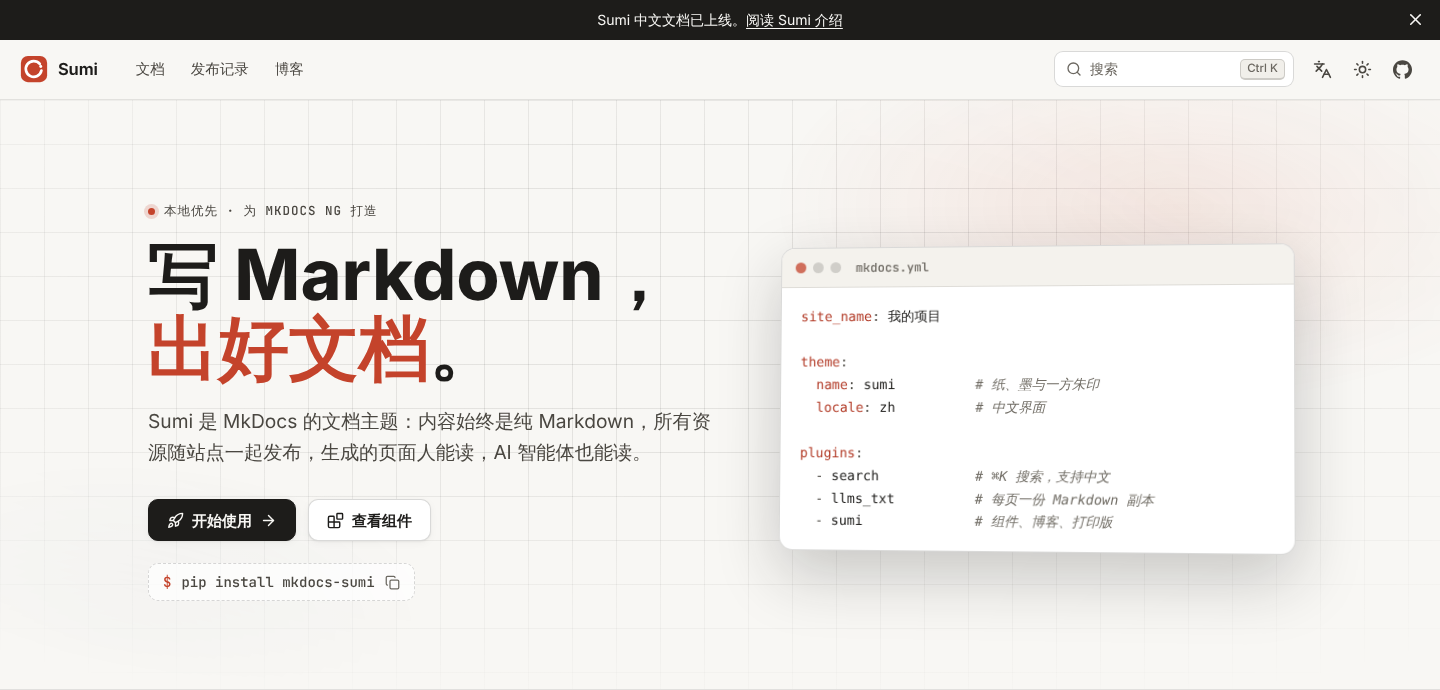
Its defining trait is that components are plain Markdown: callouts are > [!NOTE], tabs are code fences with {tab="…"}, and your source still reads well on GitHub. Fonts, icons, search, Mermaid and KaTeX all ship with the theme, with no CDN. The MkDocs NG website, Sumi’s own docs and the plugin catalog are all built with it.
Trying it takes three steps:
pip install mkdocs-sumi# mkdocs.yml
theme:
name: sumi
plugins:
- search
- llms_txt
- sumimkdocs serveHow is Sumi different from Material for MkDocs?#
First, where Material stands. Since November 2025 it has been in maintenance mode: the upstream team moved on to Zensical, with no new features and only critical fixes. According to Zensical’s announcement, that maintenance runs until May 5, 2027.
I forked Material into the MkDocs NG organization too. The package is mkdocs-ng-material, now at 9.8.0 with upstream’s 9.8.0 security fixes, and its docs are at material.mkdocs-ng.org. The theme name is still material, so your config doesn’t change:
pip install mkdocs-ng-materialSo both paths are open: install mkdocs-ng-material to keep using Material, or try Sumi.
| Material for MkDocs | Sumi | |
|---|---|---|
| Status | Critical fixes only upstream; mkdocs-ng-material maintained in the NG organization | New theme, 0.2.x, under active development |
| Maturity | Years of work, the most features and users | Released in November 2026, still filling gaps |
| Components | Extension syntax such as !!! note and === "Tab" | > [!NOTE] and {tab="…"}, so your source renders on GitHub too |
| External resources | Loads fonts from Google Fonts by default (can be turned off) | Fonts and icons ship with the theme, no CDN at all |
| Whole-site pages | Blog plugin built in; a landing page needs your own template | Landing page, blog, releases page and print edition built in |
For a new docs site, intranet or offline hosting, or one design for docs, landing page and blog, start with Sumi. If your site already relies heavily on Material, stay on mkdocs-ng-material; there’s no need to switch. If you want to try Sumi, it reads most Material content as is, and switching usually means changing two lines. See Migrating from Material.
The plugin catalog is now a website#
I also turned the MkDocs plugin catalog into a website: catalog.mkdocs-ng.org.
It updates itself every week, ranks projects by downloads and activity, and marks the plugins tested on MkDocs NG. It also discovers new plugins on PyPI automatically, so after this week’s update it lists more than 470 plugins, themes and Markdown extensions. It’s open to everyone, so I hope it’s useful whichever MkDocs-based tool you use.
If your plugin isn’t there, please open an issue.
Which way to go#
If your docs still run on MkDocs 1.6.1, my advice is to plan a move.
1.6.1 still builds today. But it hasn’t had a release in over two years, so security fixes in dependencies and newly found bugs don’t reach it. The software supply chain keeps moving, and the gap only grows the longer you stay.
There are several good options, and the right one depends on your site:
- MkDocs NG: change one dependency line; plugins, config and CI stay as they are. Most of the long-standing upstream issues are fixed, and clean builds are fast.
- Zensical: built by the original Material team, with a Rust core and fast cached builds. It’s still at 0.0.x and doesn’t run MkDocs plugins, only native rewrites of about thirty popular ones, so check that the plugins you use are among them before migrating.
- ProperDocs: led by a former MkDocs maintainer and staying close to 1.6, with its own package and command name.
I started my own fork instead of building on ProperDocs because I had different ideas about where to take it. That’s one of the good things about open source: people can try different directions, and users get to choose.
How to switch#
It’s one line: replace mkdocs with mkdocs-ng in your dependencies.
The command is still mkdocs, the config is still mkdocs.yml, and plugins and themes stay as they are.
Switching back is one line too. See the migration guide.
Finally#
Six months ago, I wrote that code is only the first half of a project’s reach; the second half is people.
I’ve given the code my best. Now I need your help:
- Try Sumi and MkDocs NG on your docs site.
- Open an issue when something breaks or you need something. The roadmap is #59; tell us what you want most.
- Contributions are welcome: code, docs, translations, or adding a plugin you use to the plugin catalog.
- If you find it useful, star mkdocs-ng/mkdocs and mkdocs-ng/mkdocs-sumi, or share this with friends who still use MkDocs.